by Alexander Bernhardt
It’s that time of year once more—the pinnacle of the Christian liturgical calendar, when the resurrection of Jesus Christ is joyously commemorated. Eastertide unites believers across denominations, whether Catholic, Syrian Orthodox, Russian Orthodox, Greek Orthodox, or Protestant, in a shared celebration of hope and renewal. Although it unites all Christians in spirit, Easter is celebrated on different dates across various denominations. This year, Catholic Easter falls on Sunday, April 5, while Orthodox Easter follows exactly one week later on April 12. Why this difference?
Historical Roots of the Divide
The split stems from the Great Schism of 1054, which fractured Christianity into Western (Catholic) and Eastern (Orthodox) branches over theological and cultural lines. A key factor emerged in 1582 when Pope Gregory XIII introduced the Gregorian calendar to correct astronomical drifts in the older Julian calendar, still used by Orthodox churches. Today, the Julian lags 13 days behind, shifting the vernal equinox—March 21 for Catholics, April 3 for Orthodox. Both traditions follow the Council of Nicaea’s rule from 325 AD: Easter on the first Sunday after the first full moon following the equinox (Britannica, 2026).
Date Calculation Breakdown
Catholics compute via refined Gregorian tables, yielding dates from March 22 to April 25. Orthodox, using Julian reckoning, land between April 4 and May 8 (Gregorian equivalent). In 2026, close lunar alignments make them just a week apart—rare, as they coincide only about 30% of years. This year’s one-week gap highlights how full moons align similarly, yet calendars diverge just enough (New Advent Catholic Encyclopedia).
| Aspect | Catholic Easter | Orthodox Easter |
| Calendar | Gregorian | Julian |
| Date Range | March 22–April 25 | April 4–May 8 (Gregorian) |
| Lent Length | 40 days | 40 days + Holy Week |
| Fasting | No meat Fridays | No animal products; vegan-like |
| 2026 Specific | April 5 | April 12 |
Traditions in Contrast
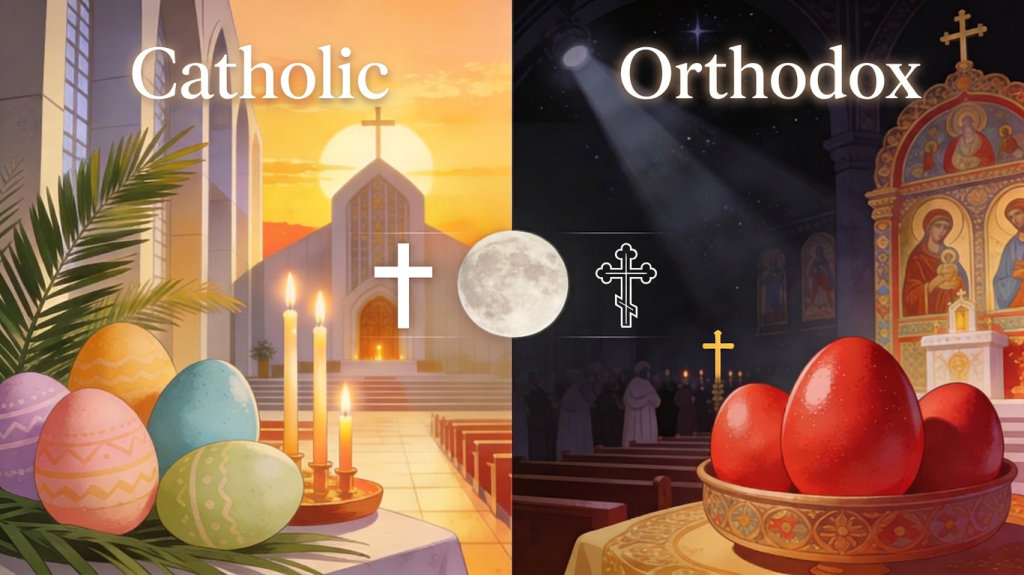
Catholics shine with Palm Sunday processions, poignant Good Friday crucifix veneration, and luminous Easter Vigils. Orthodox Holy Week builds to dramatic midnight services: lights extinguish symbolizing Christ’s death, then blaze with “Christ is Risen!” proclaimed in thunderous joy. Eggs unite them—Catholics dye in pastels; Orthodox favor blood-red, cracked in games evoking the tomb’s stone rolling away. Yet Orthodox Lent demands stricter abstinence, shaping deeper communal bonds.
As someone blending cultures, I’ve learned these differences aren’t divides, but doorways to richer connections. Whether you’re celebrating on April 5 or cracking eggs on the 12th, the joy of resurrection unites us all.
We wish all of you a good Easter, filled with hope, family, and maybe a friendly egg-tapping challenge. Christ is risen—indeed He is!
What’s your favorite Easter tradition? Drop it in the comments!
Sources:
Britannica. (2026, March 25). East-West Schism. https://www.britannica.com/event/East-West-Schism-1054
Catholic Encyclopedia. (n.d.). Easter controversy. New Advent. https://www.newadvent.org/cathen/05228a.htm
The author wrote the blog using DeepSeek as a tool and assistant. After using this tools/services, the author reviewed and edited the content as needed and take(s) full responsibility for the content of the work.
Leave a Reply